
Communication for Clinicians
Better Conversations Can Lead to Better Outcomes
Clinical knowledge matters.
But what happens between clinician and patient can influence whether that knowledge is understood, trusted and acted upon.
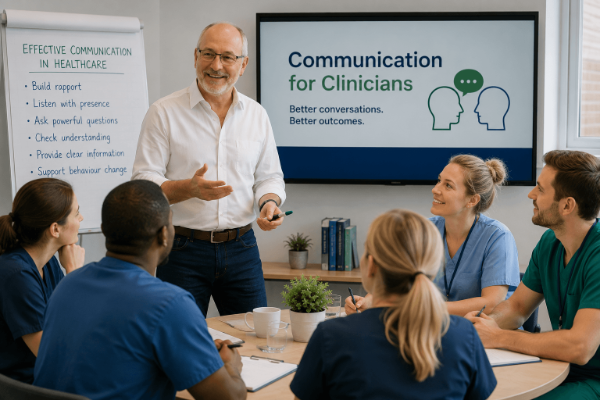
Communication for Clinicians is a practical training programme designed to help healthcare professionals make better use of the conversations they are already having.
The aim isn't to make consultations longer.
It is to make the available time more useful.
[Discuss Training for Your Team]
Beyond Giving Good Advice
Healthcare professionals are often very good at explaining what someone needs to do.
But giving accurate information doesn't guarantee understanding, engagement or action.
A patient may understand the advice perfectly and still feel unable to follow it.
Another may appear resistant when they are actually frightened, uncertain or responding to previous experiences.
Sometimes the most useful question isn't:
“How can I explain this more clearly?”
but:
“What is getting in the way of this person being able to act?”
That shift can change the conversation.
What Will We Explore?
Communication for Clinicians develops practical skills that can be applied within everyday clinical conversations, including:
- establishing rapport quickly and appropriately;
- listening for what matters to the patient;
- asking more useful and precise questions;
- recognising assumptions, generalisations and missing information;
- exploring expectations, concerns and barriers to change;
- using language that supports confidence and capability;
- responding to resistance with curiosity rather than confrontation;
- recognising when to advise, when to question and when simply to listen;
- helping patients identify realistic choices and next steps.
The emphasis throughout is on practical application, not communication theory for its own sake.
Listening for the Story Behind the Problem
Patients don't arrive with symptoms alone.
They bring experiences, expectations, fears, beliefs and stories about what those symptoms mean.
“My back is damaged.”
“Exercise always makes it worse.”
“Nothing works for me.”
“I'm just getting old.”
These statements contain more than information. They can influence what someone expects, notices and believes they are capable of doing.
Rather than immediately correcting or challenging the person, effective communication begins with curiosity:
“What does that mean to you?”
“How did you come to that conclusion?”
“Is that always the case?”
“What would help you feel more confident?”
Better questions can reveal possibilities that advice alone may miss.
Communication Within Real Clinical Practice
Healthcare conversations take place within real constraints.
Appointments are limited. Workloads are high. Patients may be anxious, frustrated or overwhelmed.
This programme therefore isn't about turning clinicians into therapists or adding another lengthy process to the consultation.
It is about developing greater awareness, precision and flexibility within the conversations already taking place.
Sometimes a small change in a question, an assumption or the way information is framed can make a significant difference to what happens next.
Who Is It For?
Communication for Clinicians can be adapted for healthcare professionals including:
Doctors | Nurses | Physiotherapists | Occupational Therapists | Allied Health Professionals | Rehabilitation Professionals | Healthcare Assistants | Clinical Educators
Training can be tailored to the needs and context of individual teams and organisations.
Training for Your Organisation
Communication for Clinicians can be delivered as a focused workshop or developed around the particular communication challenges facing your service or team.
Related areas can include patient engagement, behaviour change, self-management, difficult conversations and coaching skills in healthcare.
[Discuss Communication Training for Your Team]